From Implacable Foe to Unlikely Guardian:
Why CHS Now Defends No. 1 Poultry
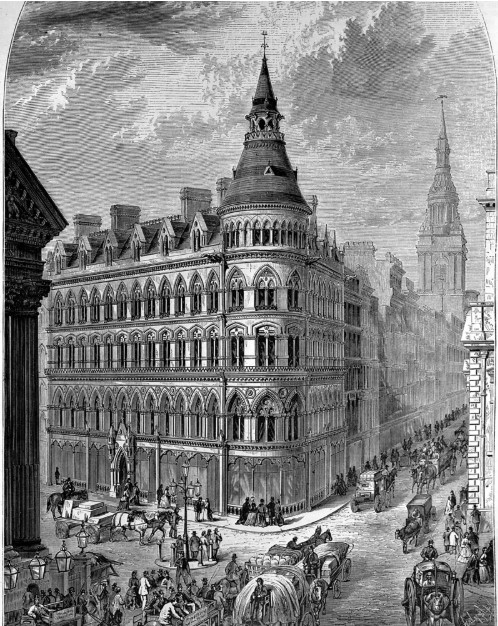
History has a wry sense of humour. For nearly two decades, the City Heritage Society fought one of the longest and most hard-fought conservation battles in British planning history to prevent No. 1 Poultry from being built. We stood shoulder-to-shoulder with SAVE Britain’s Heritage, Historic England (then English Heritage), and countless other conservation allies in opposing Peter Palumbo’s scheme to demolish eight listed Victorian buildings at the Mappin and Webb site. We took our case through public inquiries, planning committees, the Court of Common Council, the Secretary of State’s office, and finally — in March 1990 — to a “famous victory” in the Court of Appeal. My predecessor as Chairman, C. Douglas Woodward, had guided this fight all the way through and wrote to the Secretary of State in the wake of the decision, urging him not to appeal to the House of Lords after Lord Justice Woolf had declared the whole scheme “fatally flawed”.
Yet barely a year later, in 1991, the Law Lords overruled the Court of Appeal. James Stirling’s postmodern wedge rose on the ruins of those Victorian buildings we had fought to save. The Times called it “sheer destruction, a monumental act of egotism.” We agreed. It was a bitter defeat.
Now, in 2026, the City Heritage Society finds itself in the remarkable position of defending that very same building — Grade II* listed and recognised as an outstanding example of late 20th-century architecture — from inappropriate alterations. The irony is not lost on us.
The Battle We Lost (1982–1991)
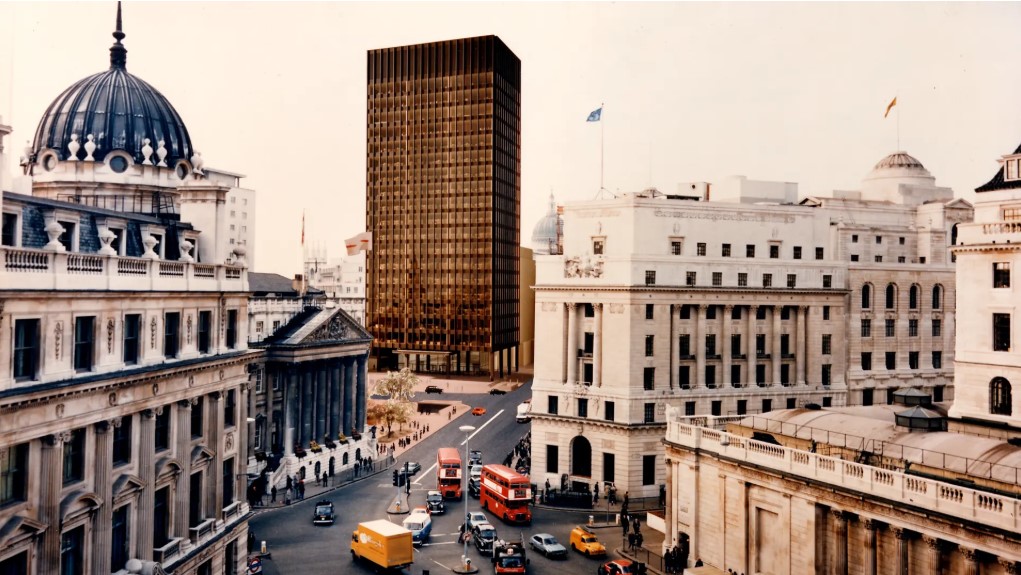
The saga began in earnest in 1982, when Peter Palumbo — whose father had started acquiring properties on the site as early as 1958 — applied for Listed Building Consent to redevelop the central area of the City around Mansion House. The scheme, designed nearly 20 years earlier by Mies van der Rohe (who had died in the interim), proposed an 18-storey tower, a new square, and an underground shopping concourse. It would involve demolishing more than 20 buildings, nine of them listed, including the exceptional Mappin and Webb building on the triangular Poultry-Bucklersbury-Queen Victoria Street site.
Our observations in February 1982 were highly critical. We wrote:
“Given the existing street pattern at Bank Junction it is inappropriate to superimpose a square at this point… The destruction of the scale envisaged is not acceptable… The group of buildings in the triangle Poultry-Bucklersbury-Queen Victoria Street should be permanently rehabilitated because of their exceptional townscape value as well as the intrinsic architectural quality of some of them… Especially important because of its key position is the Mappin and Webb building.”
In September 1982, the Court of Common Council, on a recommendation by the Planning Committee and with one or two passionate speeches (not least our then Chairman), voted unanimously to reject the scheme. We had hoped Peter Palumbo would accept the City’s overwhelming verdict and set about rehabilitating the buildings. He did not.
The Public Inquiry and Years of Struggle
By May 1984, a public inquiry into the proposals was finally scheduled. The City Heritage Society participated extensively, arguing against the demolition and pleading for a refurbishment scheme along the lines proposed at earlier public inquiries. Our small but determined group commented constructively on over 40 planning applications that year alone. Dealing with the Mansion House Square proposals was never easy, and several Committee members (some of whom we’re thankful to still count as members) worked tirelessly alongside the Chairman to make the Society’s case as effectively as possible.
After the public inquiry of May-July 1984, Palumbo submitted two alternative schemes for redevelopment in 1986. One involved total demolition of all the existing buildings, replacing them with a single triangular wedge of seven storeys — likened by Stuart Murphy to a wedge of cheese, and later by the then Prince of Wales to a 1930s wireless set. The other scheme would destroy everything except the Mappin and Webb façade — adjacent to which a 150-foot-high tower would loom, ruining the east-west view from the Royal Exchange along Poultry and Cheapside to St Paul’s. The medieval lane of Bucklersbury would disappear in both schemes.
We disliked them both. We argued again that the developer should consider a refurbishment scheme along the lines of those proposed at earlier public enquiries. Our voices, along with those of the Corporation, English Heritage (now Historic England), SAVE Britain’s Heritage, and the national amenity societies, condemned Palumbo’s plans.
In June 1987, the Planning Committee narrowly rejected the latest Palumbo proposal. When it subsequently went before Common Council, members voted overwhelmingly against it. The Chairman wrote in our annual report: “We think it most regrettable that in spite of this further rebuff Mr Palumbo is still pursuing what can only be described as a one-man obsession to rebuild the City at this sensitive point. Still refusing to accept the decision of so many he has again seen fit to appeal against the City Corporation’s decision and so the buildings on this site, which for more than a century have epitomized the City’s heart, are allowed to become increasingly run-down, a deplorable waste of prime space.”
The then Prince of Wales entered the fray at the Planning Committee’s annual dinner in December 1987. It was here that he made his now-famous remarks which accused property developers of being “more destructive of British cities than the Luftwaffe”, a view with which the Society heartily agreed!
The Turning Point: Ridley’s Decision and the Courts
Way back in June 1985, the Secretary of State had upheld his Inspector’s rejection of the Mansion House Square scheme. But that decision, while rejecting the Mies van der Rohe tower, left the door open for an alternative “new building of quality” when we believed he should have called for a scheme of conservation.
Once Palumbo had commissioned James Stirling to produce an alternative, the City Heritage Society prepared ourselves for another chapter in this seemingly endless saga. In June 1988, a public inquiry took place to determine whether Stirling’s No. 1 Poultry design should be permitted. The Society strongly objected. Anthony Hemy summarised our case: demolition would set a dangerous precedent within conservation areas and would go against the Corporation’s development plan; there was no popular support for the proposals; the refurbishment scheme suggested by English Heritage should serve as a model.
In July 1989, it was announced that Secretary of State Nicholas Ridley had allowed Palumbo’s appeal. The Corporation took legal opinion and were advised that ratepayers’ money should not be spent on further legal action. Happily, SAVE Britain’s Heritage took the decision to apply for a judicial review and the City Heritage Society contributed to the appeal costs.
March 1990: ‘A Famous Victory’
On 30 March 1990, the City Heritage Society celebrated a famous victory. The Court of Appeal quashed the Ridley decision on No. 1 Poultry, which Lord Justice Woolf said was “fatally flawed.” The Court held that Mr Ridley had failed to give adequate reasons for his departure from established Government policy on listed buildings.
Our Chairman wrote to the new Secretary of State, urging him not to appeal to the House of Lords but to encourage refurbishment of the buildings on the site. Her Majesty’s Government decided to take no further action and to let matters rest. But Palumbo, not unexpectedly, put in his own appeal to the Law Lords.
And so it was that, just 12 months after the euphoria of our famous victory, gloom and despondency came with the judges of the House of Lords deciding in favour of Lord Palumbo, closing the final chapter in a 20-year saga and sounding the death knell for the Mappin and Webb and seven other listed Victorian buildings.
The Times published a notable leader: the proposed development was “sheer destruction, a monumental act of egotism” — a verdict with which City Heritage has never come to disagree.
So What Has Changed?
No. 1 Poultry was completed in 1997. By 2016, it had been granted Grade II* listing, an extraordinarily rapid recognition of its architectural and historical significance. What was once derided as a “1930s wireless set” is now understood to be James Stirling’s last major work and an outstanding example of postmodern architecture, its striped façades, quirky turret, and bold geometry now integral to the streetscape of the Bank conservation area.
Historic England’s listing description notes that the building “has many claims to special interest,” including its status as Stirling’s final major commission before his death and its role as a key example of his late Postmodern idiom. The listing highlights the building’s “extraordinary sculptural quality,” its carefully orchestrated public spaces, and its idiosyncratic yet sophisticated use of classical and modernist references.
Heritage values evolve. Buildings once considered controversial become cherished landmarks. The passage of time allows us to reassess architectural merit with fresh eyes. What was contentious in its own era often becomes invaluable to future generations, not despite its challenging origins, but because of them. No. 1 Poultry now stands as a rare complete example of Stirling’s mature vision, and its special interest lies not just in its architectural quality but in its embodiment of a particular cultural and historical moment.
Why We’re Fighting Now
The current Listed Building Consent application (reference 25/01714/LBC) proposes alterations that would harm the significance of this Grade II* listed building. While the details of our objection are set out in our formal representation to the City of London Corporation, the essence of our concern is this: the proposals would compromise spatial relationships, significant fabric, and the carefully composed architectural narrative that makes No. 1 Poultry exceptional. The current application seeks to undo planning conditions which were crucial for the original scheme’s final consent, including by ending public access to the gardens and restaurant that the original consent deemed essential.
The City Heritage Society has always stood for rigorous, evidence-based heritage assessment. We have never accepted “no harm” claims at face value when spatial relationships or significant fabric are affected. That principle applies as much to a 1990s postmodern building as it did to Victorian commercial architecture in the 1980s.
Section 16(2) of the Planning (Listed Buildings and Conservation Areas) Act 1990 requires decision-makers to have special regard to the desirability of preserving the building, its setting, and any features of special architectural or historic interest. Policy HE1 of the City Plan 2040 reinforces this duty. The current proposals fail to meet these statutory and policy tests.
We are not opposing change for the sake of it. We recognise that listed buildings must adapt to remain viable. But adaptation must be undertaken with a deep understanding of what makes the building significant and with a commitment to preserving that significance. The current proposals do not demonstrate such understanding.
The Irony, and the Principle
There is, admittedly, a certain irony in the City Heritage Society now defending No. 1 Poultry from inappropriate change. We did not want this building. We fought with everything we had to prevent its construction. We mourned the loss of the Mappin and Webb building and its Victorian neighbours.
But that fight is over. The building exists. It is listed. It is, by any objective measure, architecturally significant, and it is substantially better than the original Mies van der Rohe scheme that we were able to prevent. Our role now is not to refight the battles of the 1980s, but to ensure that the heritage assets we have – all the heritage assets we have, including those we once opposed – are protected from harm in accordance with the law and with sound conservation principles.
This is not sentimentality. It is professionalism. Heritage protection is not about personal taste or historical grudges. It is about applying consistent, rigorous standards to the assessment of significance and the evaluation of harm. If we were to shrug and say “well, we never liked this building anyway” whenever a controversial structure faced alteration, we would be abandoning our principles.
The City Heritage Society has spent over 50 years advocating for the City’s built heritage: all of it, across all periods and styles. That includes buildings we love and buildings we once loathed. It includes medieval churches, Victorian warehouses, Brutalist masterpieces and postmodern landmarks. When a building is recognised as being of special interest, it deserves protection. No. 1 Poultry is no exception.
How You Can Help
The Listed Building Consent application is currently under consideration by the City of London Corporation. The City Heritage Society has submitted a detailed objection. If you are a member of CHS, or simply a supporter of rigorous heritage protection, we encourage you to support the Society’s work by joining us, renewing your membership, or encouraging others to join. You could also consider making your own representation to the City’s planning department if you share our concerns, using the City’s planning search function and entering reference 25/01714/LBC.
This is not about nostalgia for a battle lost. It is about defending a principle: that listed buildings, all listed buildings, regardless of their contentious origins, deserve protection from harm. The City Heritage Society will continue to make that case, even when it leads us to unexpected places.